Two federal records.
One public-health duty.
HHS and the FCC are asking what the wireless-radiation evidence means. This is the moment to demand standards built for a lifetime of real exposure—not only a short-term heating test.

The official filing paths.
Deadline language and source links were checked against the federal notices on September 18, 2026.
RF/EMF health Request for Information
- Docket
- HHS-OASH-2026-0397
- Federal Register
- Document 2026-19252
- Publication
- Scheduled September 21, 2026
- Deadline rule
- 30 days after publication
HHS asks about health evidence, exposure standards, measurement, surveillance, children and other sensitive populations, environmental effects, and federal research priorities.
RF-exposure remand record
- Docket
- ET Docket No. 13-84
- Public notice
- DA 26-997
- Released
- September 17, 2026
- Deadline rule
- 30 days after Federal Register publication
The FCC asks about device testing, non-cancer effects, children, long-term and ubiquitous exposure, technological change, and environmental impacts within the scope of the 2021 remand.
Deadline alert: do not calculate from the release date. Both notices use Federal Register publication as the trigger. Confirm the final calendar date in the official docket before submitting.
Compliance is not the same as biological safety.
The present framework answers a narrow engineering question: did a product remain below a prescribed absorption or field-strength limit under a defined test? It does not answer whether decades of pulsed, modulated, near-body, multi-source exposure protect cancer risk, fertility, pregnancy, childhood development, neurological function, mitochondrial recovery, or the environment.
Five facts require a federal response.
The court found an explanation failure.
In 2021, the D.C. Circuit remanded the FCC's decision because the agency had not adequately explained its treatment of non-cancer effects, children, long-term exposure, device testing, technological change, and environmental effects.
Two animal tumor endpoints reached high certainty.
The corrected WHO-commissioned animal-cancer review judged the evidence high certainty for increased glioma and malignant heart schwannoma in male rats.
A quantitative risk assessment exposes a large gap.
Melnick and Moskowitz calculated that the public whole-body limit is 15 to 900 times above their cancer risk-based estimates and 8 to 24 times above their male-reproductive reference levels.
Non-thermal biological action is not hypothetical in medicine.
FDA's TheraBionic P1 authorization recognizes a device that delivers specific amplitude-modulated RF frequencies and warns against use with calcium-channel blockers.
Cells can translate an EMF into calcium timing and gene control.
A 2026 Cell paper identified CYB5B as essential to an engineered EMF-responsive switch activated by rhythmic calcium oscillations—not merely generic calcium entry.
A heating limit cannot settle a lifetime timing problem.
The current public whole-body reference of 0.08 watts per kilogram traces to short-duration behavioral-disruption experiments from the 1980s and a presumed whole-body threshold of 4 watts per kilogram. Safety factors were then applied to address acute heating. That history is described directly in the 2026 Melnick-Moskowitz paper.
Phone certification also uses localized SAR limits, including the U.S. limit of 1.6 watts per kilogram averaged over one gram of tissue. These are different metrics. Neither was derived as a quantitative lifetime cancer, fertility, pregnancy, childhood-development, or bioelectric-timing standard.
What compliance can answer
- Whether a tested configuration met the applicable legal metric
- The maximum reported result under that protocol
- Whether the device can be marketed under the current rules
What compliance does not establish
- Lifetime cancer or reproductive risk
- Safety during prenatal and childhood development
- Real-world cumulative multi-radio exposure
- Waveform, pulse, phase, and recovery effects
- Safety for every genotype, disease state, or implanted device
A converging warning, not one isolated paper.
The case for action rests on independent evidence streams that answer different parts of the problem.
NTP and Ramazzini converged on a rare tumor type.
The U.S. National Toxicology Program reported clear evidence of malignant heart schwannomas and some evidence of malignant gliomas in exposed male rats. The Ramazzini Institute, using a different far-field lifetime exposure design at lower field intensities, also reported increased heart schwannomas in male rats. Different protocols converging on the same rare tumor type are a public-health signal that deserves targeted replication and risk assessment—not indefinite procedural delay.
The WHO-commissioned review then assessed the wider animal literature. Its 2026 corrigendum retained high certainty for increased glioma and malignant heart schwannoma in male rats. High certainty in animals is not a personal risk calculator; it is a strong hazard finding of exactly the kind agencies routinely use before complete human quantification is possible.
Reproductive endpoints also fall outside the logic used to set the limit.
The corrected WHO-commissioned male-fertility review was interpreted by Melnick and Moskowitz as high-certainty evidence that exposure reduced pregnancy rate in the experimental literature, with a reported linear potency used in their benchmark analysis. The same review reported adverse signals across sperm count, vitality, reproductive-organ measures, testosterone, DNA or chromatin damage, histology, and cell death.
A separate WHO-commissioned review of pregnancy and birth outcomes reported statistically significant adverse effects in experimental animals, including resorbed or dead fetuses, malformations, and reduced fetal weight or length. The certainty ratings vary by endpoint, but the policy fact does not: these outcomes were not used to derive the FCC's current public limit.
Current 0.08 W/kg whole-body public limit above the authors' one-in-100,000 cancer-risk estimates, depending on daily exposure duration.
Current whole-body limit above the authors' animal-data-derived protective reference levels.
Publish the calculations, sensitivity analyses, uncertainty choices, acceptable-risk target, and a technically complete rebuttal or replacement.
“Mixed” is not the same as biologically inactive.
Human studies are difficult because exposure is badly measured, devices and networks change during latency periods, subscription records do not equal use, self-report creates error, and population saturation can erase contrast between “exposed” and “unexposed” groups. Case-control analyses and meta-analyses have reported higher tumor risk in heavier or longer-term users, while other cohort analyses have been more reassuring.
HHS should not settle this by counting paper titles. It should audit exposure classification, laterality, cumulative call time, latency, technology era, selection, attrition, model choice, and conflicts of interest. A null result built on severe exposure misclassification is not a clean negative experiment.
The same guideline network should not be the final judge of its own framework.
Ken Karipidis, first author of the 2024 WHO-commissioned human-cancer review, is also an ICNIRP Main Commission member and vice chair. A 2025 peer-reviewed cross-review audit documented recurring participation by ICNIRP members across the WHO-commissioned review teams and identified concerns about risk-of-bias methods, evidence selection, and interpretation.
Expertise is valuable; institutional overlap is still a governance problem. HHS should require full disclosure of guideline roles, funding, prior positions, protocol deviations, excluded evidence, dissent, analytic code, and data. The health assessment must be structurally independent of the organizations whose thermal-centered guidelines are being evaluated.
If it can heal, it can harm.
The FDA approved the TheraBionic P1 for marketing under a Humanitarian Device Exemption in 2023. The handheld device places an antenna in the mouth and emits specific amplitude-modulated RF frequencies for adults with advanced liver cancer after other treatments have failed.
FDA states that these frequencies may stop cancer cells from dividing and says the device should not be used by people receiving calcium-channel blockers. Related published work identifies a voltage-gated calcium-channel mechanism.
The conclusion is not that a therapeutic protocol and a cellphone are equivalent. It is more fundamental: low-energy RF can be biologically active in a parameter-specific way. Once that fact is accepted in medicine, safety science must test carrier, modulation, pulse structure, duration, tissue, and biological state—not presume that “below the heating limit” means biologically inert.
Read FDA's TheraBionic P1 overview ↗Therapeutic specificity and safety specificity are the same scientific principle viewed from opposite sides.
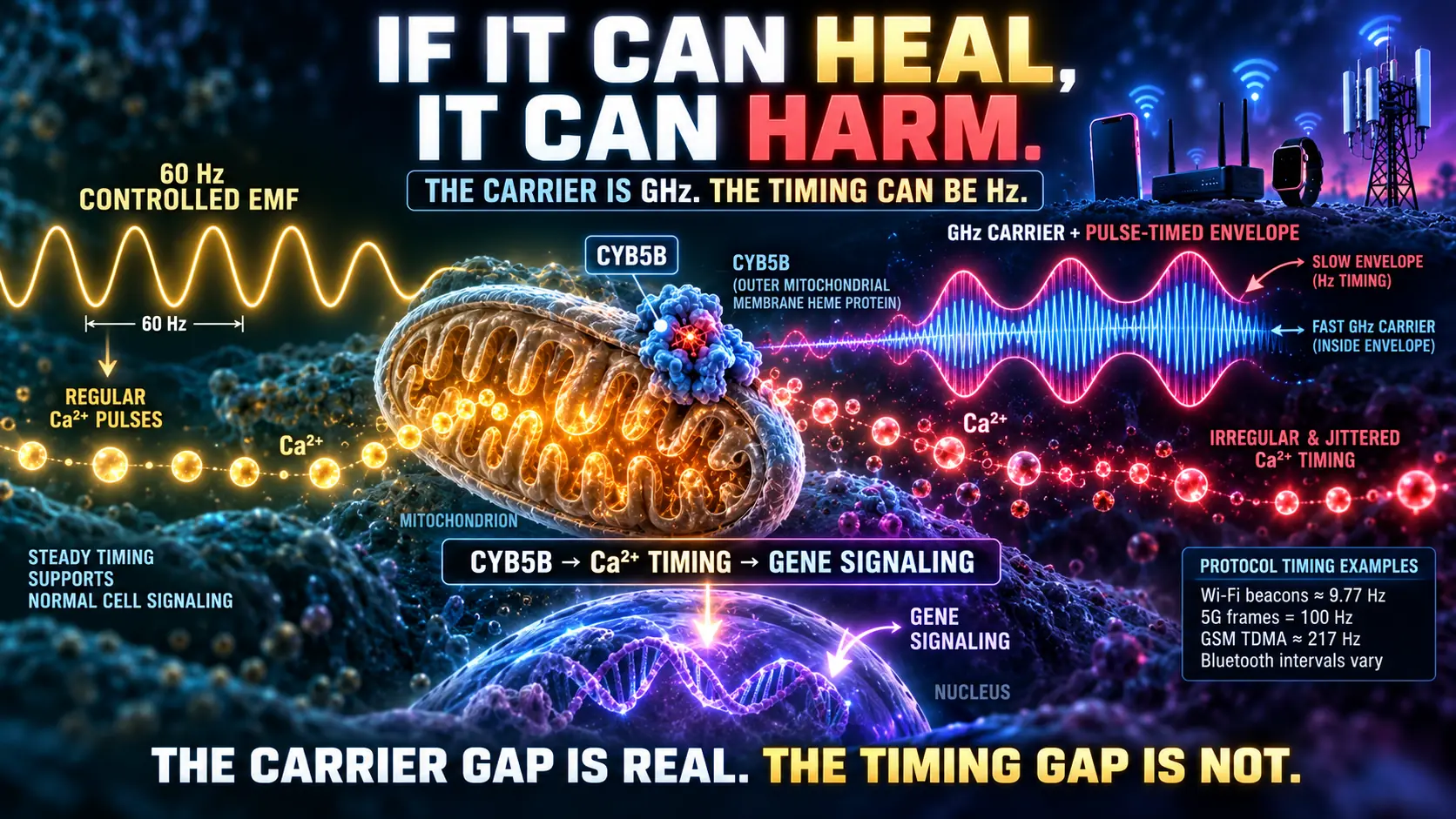
Biology reads timing, not only energy.
A wireless signal has a carrier, but it also has envelopes, frames, bursts, duty cycles, transitions, repetition intervals, and recovery gaps.
Carrier frequency
The rapid oscillation used to carry information—often megahertz or gigahertz in wireless systems.
Envelope and framing
The slower pattern by which amplitude, packets, slots, beacons, or bursts turn on, recur, and change.
Biological recovery
The time membrane voltage, calcium, redox state, and mitochondrial function need to return toward baseline.
A signal can be perfectly ordered for a modem yet function as timing noise for a cell.
A defined EMF was converted into rhythmic calcium and gene expression.
In the 2026 Cell study, a CRISPR screen identified cytochrome b5 type B, or CYB5B, as an essential mediator likely acting as the EMF sensor in an engineered gene switch. Activation depended on rhythmic oscillatory calcium dynamics rather than generic calcium influx.
The experiment used a defined 60-hertz, 2-millitesla field and an engineered biological circuit; it is not a cellphone exposure study. Its significance is that it supplies concrete molecular hardware and a measurable coding variable. Cells can translate an electromagnetic input into a calcium waveform and then into gene-level control. Federal research should now test whether real-world wireless waveforms perturb endogenous calcium timing under relevant conditions.
Voltage-sensitive gates
S4 helices are established voltage sensors in ion channels. RF Safe predicts that susceptible field conditions can bias when such channels open, close, or recover, changing the amplitude, frequency, phase, width, location, or termination of calcium signals.
Mitochondrial amplification
Mitochondria convert calcium and fuel signals into ATP, redox output, membrane potential, repair capacity, and cell-fate decisions. Mistimed input can therefore be amplified into incomplete recovery or maladaptive stress signaling.
Reaction probabilities
Flavins, hemes, iron-sulfur centers, quinones, and radical intermediates create plausible field-sensitive chemistry. The federal task is to measure radical lifetime, product yield, redox timing, orientation, and downstream amplification under characterized waveforms.
Bioelectrical dissonance → recovery debt → low-fidelity biology.
RF Safe uses bioelectrical dissonance for a persistent mismatch between environmental electromagnetic timing and endogenous control. When perturbations recur faster than the system restores baseline, recovery debt accumulates. The resulting loss of precision is low-fidelity biology.
This is upstream of any one diagnosis. Membrane excitability, calcium coding, mitochondrial quality control, DNA repair, immune coordination, apoptosis, development, and senescence are shared control systems. A chronic loss of fidelity could therefore create a meta-disease state: not a new disease label, but a background condition that increases the probability that other biological failures persist.
Quality-control failures that once occupied the tail of a distribution occur more often.
Reduced reserve and incomplete recovery move vulnerability forward in time.
Genotype, tissue demand, illness, development, and co-exposures shape the path of least resistance.
A brief error while tissue is being patterned can persist long after the original exposure ends.
Co-contributors belong inside the model.
Air pollution, ultra-processed diets, poor nutrition, sleep loss, endocrine-active chemicals, infection, psychosocial stress, genetic predisposition, and medical interventions can also alter calcium, redox balance, membrane excitability, metabolism, and recovery. That does not excuse RF from investigation. It predicts interaction: when several insults tax the same control systems, errors can stack faster and follow the weakest biological pathway.
The public should not have to engineer around an obsolete standard.
RF Safe asks HHS and the FCC to move from a narrow compliance framework to prevention, measurement, disclosure, and lower-exposure infrastructure.
Fully implement Public Law 90-602.
Use the federal electronic-product-radiation authority now codified at 21 U.S.C. sections 360hh through 360ss to research exposure, evaluate hazards, develop minimization techniques, publish useful information, coordinate agencies, and update product-performance standards.
Restore an independent national RF toxicology program.
Restart long-term, lifetime, prenatal, juvenile, reproductive, and multigenerational research with modern 4G, 5G, Wi-Fi, Bluetooth, DECT, wearable, and mixed-source waveforms; independent dosimetry; blinded pathology; preregistration; and open data.
Test waveform at equal average power.
Hold SAR or power density constant while changing pulse repetition, envelope, duty cycle, peak-to-average ratio, rise time, framing, polarization, beamforming, and recovery interval. Measure the full biological time series before, during, and after exposure.
Create child- and pregnancy-specific protections.
Treat prenatal development, infancy, childhood, puberty, and germ-cell development as distinct exposure classes. Adult models and short-duration heating assumptions cannot simply be presumed protective for developmental timing.
Build exposure and health surveillance.
Record cumulative duration, near-body position, network generation, multiple simultaneous radios, waveform, anatomy, age at first exposure, and latency. Link transparent exposure data to registries and longitudinal cohorts while protecting privacy.
Require truthful disclosure and real radio control.
Give consumers easily accessible device test data, body-separation assumptions, simultaneous-transmission results, adaptive-power behavior, and hardware or operating-system controls that reliably disable radios not in use.
Make fiber, Ethernet, PoE, and Li-Fi the indoor alternative.
Mandate Li-Fi compatibility for high-data indoor use—especially in schools, childcare, healthcare, and workplaces—while using fiber and Ethernet as the fixed backbone. Connectivity does not require maximum radio dependence.
Reform Section 704 and restore local health authority.
Congress should repeal or substantially reform health-based preemption under Section 704 while the federal standard remains unresolved, and restore a meaningful environmental-health role for EPA and local communities.
Guarantee independent review.
Separate health evaluation from guideline defense. Publish conflicts, funding, protocols, exclusions, raw data, analytic code, minority views, and agency reasoning in a form the public and independent scientists can audit.
Issue protective guidance while research proceeds.
Recommend distance, speaker mode, wired connections, radios off when unnecessary, no unnecessary body contact, and wired or optical infrastructure in fixed settings. Uncertainty is a reason to reduce avoidable exposure, not a reason to preserve avoidable exposure.
What “RF Safe approved” should mean
RF Safe can support products and infrastructure that rely on disclosed physics rather than magical claims: optical connectivity, wired alternatives, directional designs used correctly, and products tested to ensure they do not force a device to compensate by increasing transmit power.
What it can never mean
No sticker, chip, pendant, case, or shielding accessory can substitute for protective standards. Any product that obstructs an antenna unpredictably, hides test conditions, or promises universal protection raises a red flag. Policy remains the first line of defense.
Two concise comment foundations.
Personalize these drafts. Add your expertise, experience, priorities, and a few primary sources. Do not publish private medical or identifying information you do not want in a permanent public record.
Docket HHS-OASH-2026-0397
ET Docket 13-84 · DA 26-997
The federal notices and RF Safe action package.
Local copies prevent broken agency links from interrupting the work. Always check the live docket for amendments and the controlling deadline.
Sources readers and agents can verify.
- HHS Request for Information, Federal Register document 2026-19252
- HHS docket HHS-OASH-2026-0397
- FCC Public Notice DA 26-997 landing page · official PDF · official text
- Environmental Health Trust v. FCC, 9 F.4th 893 (D.C. Cir. 2021)
- Public Law 90-602, Radiation Control for Health and Safety Act of 1968 · 21 U.S.C. § 360ii
- NTP Technical Report 595: GSM-modulated RF exposure
- Falcioni et al., Ramazzini Institute lifetime rat study
- Mevissen et al., WHO-commissioned animal-cancer review · 2026 corrigendum
- Cordelli et al., male-fertility review · corrigendum
- Cordelli et al., pregnancy and birth-outcomes review
- Melnick and Moskowitz, 2026 quantitative risk assessment
- Cross-review audit of WHO-commissioned RF systematic reviews · Karipidis et al. human-cancer review
- FDA TheraBionic P1 overview · CaV3.2 and calcium-influx mechanism paper
- Kim et al., 2026 Cell paper on CYB5B, rhythmic calcium and EMF-responsive gene control
- 47 U.S.C. § 332(c)(7), including Section 704 environmental-effects preemption
Clear answers before you file.
What are the two federal wireless-radiation proceedings?
HHS is opening Request for Information docket HHS-OASH-2026-0397 on RF and electromagnetic-field exposure and health. The FCC has released Public Notice DA 26-997 in ET Docket 13-84 to refresh the record on issues returned to it by the D.C. Circuit in 2021.
When are comments due?
Each notice states that comments are due 30 days after its publication in the Federal Register. The HHS notice is scheduled for publication on September 21, 2026. The FCC notice was released September 17, 2026, but its Federal Register publication date was not posted when this page was verified on September 18. Always confirm the controlling date in the official docket before filing.
What does the Melnick-Moskowitz 900-times figure mean?
It is the upper end of a peer-reviewed comparison between the current 0.08 W/kg public whole-body limit and animal-data-derived SAR estimates associated with a one-in-100,000 extra lifetime cancer risk under stated exposure-duration assumptions. It is not a claim that every phone produces 900 times a personal safe dose.
Did the 2021 court decision invalidate the FCC limits?
No. The D.C. Circuit left the limits in force but held that the FCC had not provided a reasoned explanation for its treatment of non-cancer effects, children, long-term exposure, device testing, technological change, and environmental effects. It remanded those issues to the agency.
Why comment to both HHS and the FCC?
HHS is asking broad health, standards, research, surveillance, disclosure, and sensitive-population questions. The FCC proceeding is narrower and tied to its court remand. Filing in both records helps connect independent health analysis to the regulator that controls communications-device compliance.
What is low-fidelity biology?
Low-fidelity biology is RF Safe's testable systems-biology framework for asking whether repeated environmental stress can reduce the precision of membrane voltage, calcium timing, mitochondrial recovery, redox signaling, repair, and developmental control. It is a research framework, not a clinical diagnosis.
Can a phone case or sticker replace protective standards?
No. Policy, infrastructure, distance, and genuine radio-off choices come first. Products should be evaluated by physics, transparent testing, correct-use instructions, and whether they avoid designs that can make a phone increase transmit power. No accessory makes unrestricted exposure safe.
What makes a public comment useful?
Identify the docket and the questions you are answering, state your perspective, make specific requests, link primary sources, explain why each source matters, and add relevant personal or professional experience without publishing private health or identity information you do not want in a public record.
Do not leave the federal record to the institutions defending the status quo.
Ask HHS to build an independent health record under Public Law 90-602. Ask the FCC to answer the court with modern science. Demand lifetime risk assessment, child-specific research, waveform-aware testing, transparent conflicts, truthful disclosure, restored toxicology, local authority, and Li-Fi-compatible infrastructure.
Make the record visible.
Share the official filing paths and the evidence behind RF Safe’s requests.
Answer the questions the agencies actually asked.
A focused comment with numbered questions, primary citations, and specific remedies is more useful than a long list of conclusions.
HHS: where RF Safe's requests fit
Standards and below-limit effects
Exposure classification
Surveillance
Sensitive populations
Environment and infrastructure
Research priorities and recommendations
FCC: answer the remand directly
Testing procedures
Explain why fixed spacing, selected transmit modes, short averaging, isolated radios, and maximum-SAR snapshots can miss adaptive power, contact use, simultaneous transmission, cumulative exposure, and waveform characteristics.
Children and long-term exposure
Place developmental windows, lifetime use, device ubiquity, changing network protocols, sensitive populations, and non-cancer outcomes squarely in the record.
Environmental effects
Ask for transparent, independent studies of plants, pollinators, birds, wildlife, and cumulative infrastructure exposure, with appropriate sham controls and field characterization.
Scientific rigor
Meet the FCC on methodology: state sample size, dosimetry, blinding, endpoint, replication, exposure relevance, limitations, and why a cited source changes the agency's reasoning.